What does the spleen do and how to tell if it hurts
28 October 2026


28 October 2026
Most people think about their spleen twice in a lifetime. Once when an ultrasound report mentions its size. And once when something suddenly stabs under the left ribs. Yet this small organ filters all of your blood every day, helps your immune system recognize bacteria and keeps a reserve of blood cells in case you bleed.
Below we explain where the spleen sits, what it actually does, if you can live without it and how to tell spleen pain from stomach or pancreas pain. We also cover when pain under the left ribs means "book a doctor" and when it means "call an ambulance now".
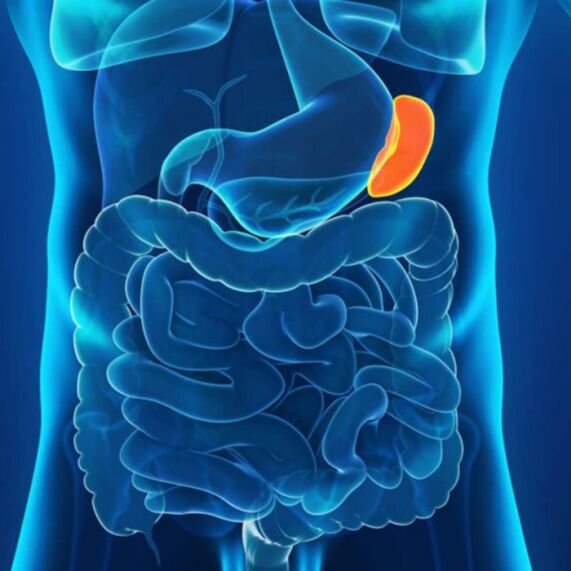
The spleen sits in the upper left part of your belly, behind the stomach, protected by the lower left ribs. In adults it is roughly the size of a fist, long and slightly bean-shaped. Its neighbors are the stomach, the left bend of the large bowel, the left kidney and the tail of the pancreas. That crowded neighborhood is exactly why pain in this area is so easy to confuse.
Inside, the spleen has two parts. The red pulp is full of blood and works like a sieve. The white pulp is lymphoid tissue, where immune cells mature and "train". A thin capsule covers the organ. It barely stretches. Any quick swelling feels like heaviness or a dull ache.
You usually cannot feel a healthy spleen with your fingers. It hides completely under the ribs. Some people have tiny extra spleens. They cause no harm and often turn up by chance on an ultrasound. A rare variant is a wandering spleen. The ligaments that should hold it in place are weak, and it moves around the abdomen. The danger is that its blood vessels can twist, and then surgery is needed.
In short, the spleen filters blood, supports immunity and stores a reserve of blood cells. The MSD Manual lists these same three big jobs. Let's look at each one.
A red blood cell lives about 120 days. Then it ages. Old cells get stiff and can't squeeze through the narrow gaps of the red pulp. That's where they get caught. Macrophages, the "cleanup" cells, break them down, and the iron goes back into your body to build new red cells.
The spleen also pulls damaged cells, cell fragments and some bacteria out of the blood. In adults, this quality control is its main job.
The white pulp makes lymphocytes and antibodies. The spleen is especially good at fighting bacteria with a thick outer capsule: pneumococcus, meningococcus and Haemophilus influenzae. Other parts of the immune system recognize them less well. That's why people without a spleen struggle more with these infections. More on that below.
The spleen holds a reserve of platelets, the cells that stop bleeding. According to MSD, about a third of all your platelets are usually inside the spleen. During an injury or heavy bleeding, this reserve goes into circulation. Before birth, the spleen also makes blood cells. After birth, the bone marrow takes over almost all of that work.
Here is everything the spleen does in one table:
| What it does | How it works | What happens if it fails |
|---|---|---|
| Filters blood | Catches old and damaged red cells and cell fragments | Abnormal red cells appear in the blood, sometimes anemia |
| Fights infection | Makes lymphocytes and antibodies, traps encapsulated bacteria | Higher risk of severe bacterial infections |
| Stores a reserve | Holds part of the platelets and white cells | An enlarged spleen traps more cells, and fewer stay in the blood |
| Makes blood before birth | Produces blood cells in the fetus | This job is almost switched off in adults |
The honest answer to "what does the spleen do" is: several things at once. And all of them involve blood.
Yes. Doctors remove the spleen after severe injury, in some blood disorders, and for cysts or tumors. People go on to live full lives. The liver and lymph nodes take over part of the work.
But the spleen is not spare. Without it, your body fights encapsulated bacteria less well. Any infection can get serious faster. As the NHS explains, after removal you need vaccines against pneumococcus, meningococcus and Haemophilus influenzae type b, plus a flu shot every year. Some patients also take preventive antibiotics. If you have no spleen and get a fever, don't wait a few days. See a doctor right away.
Children sometimes need this surgery too, for example in inherited anemias. We described how it works in our article on laparoscopic spleen removal in children.
The spleen tissue itself has very few pain receptors. What hurts is the capsule when a swollen spleen stretches it, or the lining of the abdomen nearby if there is inflammation or blood. That's why the pain is vague and its source is easy to miss.
Spleen pain usually feels like this:
None of these symptoms alone proves the spleen is the problem. A doctor's exam, a blood test and an ultrasound will tell.
Most often the pain comes from swelling that stretches the capsule. Infections are a frequent cause, especially mononucleosis, when the spleen swells and its capsule becomes fragile. Sharp, sudden pain may point to a splenic infarction, where a clot cuts off blood to part of the organ. An abscess, a pocket of pus, usually comes with a high fever. Cysts and tumors can press on the capsule. Blood disorders (leukemia, lymphoma, hemolytic anemia) and liver disease with blood backing up form another group. Finally, there is injury: a blow to the left side, a fall, a car crash.
MedlinePlus points out that spleen problems are usually secondary. They start somewhere else: in the liver, the blood or the immune system. Doctors don't look for a "sick spleen". They look for the cause.
The causes are mostly the same as in men, with a few differences. Autoimmune diseases such as lupus are more common in women, and they can enlarge the spleen. During pregnancy, the womb pushes organs upward. Heaviness under the ribs becomes more common. A rare but important case is a splenic artery aneurysm, a bulge in the vessel that is found more often in women. The danger is that it can burst during pregnancy. Sharp left-sided pain in a pregnant woman means calling an ambulance right away. Pain in the lower left belly, on the other hand, is more often linked to the ovary or bowel than to the spleen.
Doctors rarely diagnose "spleen inflammation" as such. People usually mean an infection, an abscess or an infarction. The signs look alike: high fever with chills, pain under the left ribs that gets worse when you breathe in, weakness, sometimes nausea. You don't treat this at home. You need tests and a doctor.
Several organs share the space under the left ribs. Only a doctor can pin down the source. Still, a few clues help you get your bearings:
| Organ | Where and how it hurts | Other clues |
|---|---|---|
| Spleen | Left side under the ribs, dull or pulling, spreads to the left shoulder | Early fullness, recent infection or injury, abnormal blood count |
| Pancreas | Upper belly, below the breastbone, often wraps around to the back | After fatty food or alcohol, vomiting that brings no relief |
| Stomach | Below the breastbone, closer to the middle | Linked to meals: on an empty stomach or right after eating, heartburn, belching |
| Left kidney | Lower back and side, may spread to the groin | Changes in urine, frequent urination, fever |
| Heart | Chest, pressing or burning, spreads to the left arm or jaw | Shortness of breath, cold sweat, fear. Call an ambulance |
This table doesn't replace an exam. If the pain doesn't go away or keeps coming back, don't guess. Get checked.
The main danger is a rupture. It's not rare. In blunt abdominal trauma, the spleen is injured more often than any other abdominal organ, says the MSD Manual. An enlarged spleen tears even more easily, sometimes from a minor bump. Bleeding may start days or even weeks after the injury.
Call an ambulance right away if:
Until help arrives, lie down. Skip food, painkillers and heating pads. Heat can make bleeding worse, and pills blur the picture for the doctor.
How doctors treat the spleen depends on the cause. There is no special "spleen" treatment plan. An infection gets one treatment, a clot another, a blood disorder a third. First, the doctor finds out what is going on with a complete blood count, liver tests, an abdominal ultrasound and sometimes a CT or MRI scan.
Medication is always matched to the diagnosis. For a bacterial infection or abscess, a doctor may prescribe antibiotics, often along with drainage. If viral hepatitis is the cause, antivirals are needed. A clot in the splenic or portal vein is treated with blood thinners. Blood disorders call for their own treatment, prescribed by a hematologist. Painkillers are acceptable only after an exam and on a doctor's advice.
Products sold to "cleanse" or "restore" the spleen have no evidence behind them. Self-chosen painkillers are risky too. Anti-inflammatory drugs affect blood clotting, and with low platelets that can lead to bleeding.
"What can I take when my spleen hurts?" is one of the most common questions. The answer is simple: your doctor decides after an exam. Herbal teas don't remove the cause of the pain. They just give the disease time to progress, and with a rupture or infarction, time matters most. Plain water is fine if there's no sign of an emergency and your doctor hasn't said otherwise.
If a blood disorder is behind the problem, a hematologist takes over. The hematology service at Oberig clinic treats both benign and malignant blood diseases: anemias, leukemias, lymphomas, myelofibrosis. It works inside a multidisciplinary clinic. Other specialists join in when needed. Treatment is available as an inpatient or in a day hospital, with your own doctor following you and urgent help available around the clock. You can book a visit with a hematologist directly.
Honestly, there isn't much you can do at home. You can avoid making things worse and judge the situation correctly. If the pain is severe, sudden or started after an injury, don't wait and call an ambulance. With moderate pain, rest and skip sports and heavy physical work. Don't warm your belly or massage the left side. It is also better not to take painkillers "just in case", because they mask the symptoms. Then book a visit with a general doctor in the next few days and bring your previous tests and ultrasound reports.
Even mild pain that goes away within an hour is worth a routine check, especially if it keeps coming back.
There is no special "spleen diet", and no foods that harm the spleen in particular. But some things hit it through the liver, the blood or injury.
First, blows and contact sports while the spleen is enlarged, for example after mononucleosis. Second, alcohol: it damages the liver, and a damaged liver makes blood back up into the spleen. Third, neglected infections and taking antibiotics without a prescription. Add to that delayed treatment of liver and blood diseases and missed vaccines if the spleen has already been removed.
What helps the spleen is what helps the rest of your body: a healthy weight, moderate activity, routine checkups and seeing a doctor on time if you have an unexplained fever or abnormal blood tests.
Life expectancy is not limited. Living safely without a spleen comes down to vaccines and taking infections seriously: with a fever, see a doctor right away.
Usually not. A healthy spleen hides under the ribs. If you can feel its edge, get an ultrasound and show the result to a doctor.
That's a side stitch. It happens in healthy people during exercise and goes away with rest. Experts still debate the exact cause. Don't blame the spleen alone. Pain that doesn't ease at rest is what should worry you.
It can. The spleen often swells in the second or third week of illness. That's why doctors ask you to avoid contact sports and heavy exercise for several weeks after mono.
Start with a general practitioner or family doctor. Then, depending on the cause, a hematologist, gastroenterologist, infectious disease specialist or surgeon can help. With an injury or severe pain, go straight to the emergency department.
Most often it's an enlarged spleen caused by infection, liver disease or a blood disorder. Injuries, cysts, infarction and abscesses are less common. Tumors that start in the spleen itself are rare.
Come in for a checkup if you've had a pulling feeling under your left ribs for more than a day or two, your ultrasound report mentions the spleen, or your blood test shows abnormal platelets or white cells. At Oberig clinic, we perform abdominal ultrasound on an expert-class ACUSON Sequoia (Siemens) scanner, and you get the report right after the scan. A general practitioner, gastroenterologist or hematologist will go over the results with you and explain the next steps.
Book by phone at +38 044 521 30 03 or online.