Why gallstones form and how they are treated
5 November 2026


5 November 2026
Gallstones are often found by chance. You go for an ultrasound for another reason, and the report mentions "stones". Other people need no convincing: they've already had an attack of pain under the right ribs and want to know where stones come from and if they can get rid of them without surgery.
Below we honestly cover what stones are made of, which types exist, what symptoms they cause, how to recognize biliary colic and when to call an ambulance. And separately, the most popular question: can foods, herbs or pills dissolve them?
The gallbladder stores bile made by the liver and releases it into the bowel when you eat. Bile contains cholesterol, bile acids, bilirubin and water. When the balance of these substances is off, crystals form. First comes thick "sand", called sludge. Over time the crystals clump into stones.
It's a very common problem. According to the MSD Manual, about 14% of adults in the US have gallstones, and in some Northern European countries nearly 20% do. Most people don't know, because stones can cause no symptoms for years.
Most often, bile becomes overloaded with cholesterol, while the gallbladder squeezes sluggishly and bile sits in it too long. Several factors lead to this, and they usually combine.
Women form stones more often because of estrogen, and the risk rises during pregnancy and with hormonal contraception. Extra weight and diabetes count too. Rapid weight loss, fasting and weight-loss surgery also encourage bile to stagnate. Age and genes matter. The risk is higher after 40 and when close relatives have had stones. A separate group includes blood disorders that destroy many red blood cells, and liver cirrhosis. Long-term IV feeding and inactivity add to the picture.
Often nobody can say exactly why a particular person got stones. It's usually a mix of genes, metabolism and lifestyle. That's why stones can appear even in people who eat well.
Stones are grouped by what they're made of. That determines if trying to dissolve them makes any sense.
| Type | Made of | More common in | Can medicine dissolve it? |
|---|---|---|---|
| Cholesterol | Mostly cholesterol, yellowish | The most common type: over 85% of stones in Europe and the US, says MSD | Sometimes, if small and calcium-free |
| Black pigment | Bilirubin and calcium | Blood disorders with red cell breakdown, cirrhosis | No |
| Brown pigment | Bilirubin, fats, bacteria | Infection in the bile ducts | No |
| Mixed | Cholesterol, calcium, pigments | Often older people | Usually no |
An ultrasound gives only a rough idea of the type. Stones with calcium cast a dense shadow and show up even on a plain X-ray, while pure cholesterol stones don't. The exact makeup is known only after removal. So promises to "dissolve any stones" have no basis: for most stones, medicine simply doesn't work.
Cholesterol stones are the only type that can, in theory, be dissolved with medicine. Even then, there are many conditions. More on that below.
Most often there are no symptoms at all. MSD notes that people with "silent" stones develop symptoms at a rate of about 1-4% per year. Symptoms appear when a stone moves or blocks the gallbladder outlet.
Important: heartburn, belching and general "poor digestion" without attacks of pain are usually not caused by stones. Removing the gallbladder doesn't help with these complaints, so doctors don't rush into surgery because of them.
Colic is a spasm that happens when a stone briefly blocks the gallbladder duct. The pain is severe and steady, builds within minutes and lasts from half an hour to a few hours, then fades. You can't find a comfortable position. A dull ache may remain afterward.
What can you do during an attack? Stop eating, lie down and wait out the first minutes calmly. If a doctor has already prescribed an antispasmodic for exactly this situation, take it as instructed. Don't try new medicines on your own, and avoid bile-stimulating remedies and "cleanses". If the pain passes, book a doctor the next day: the first attack is a sign that the stones have "woken up".
Call an ambulance if the pain lasts more than a few hours, or you develop a fever with chills, yellow skin or eyes, dark urine or pale stools. According to the NHS, these are signs of complications: an inflamed gallbladder, a stone in the duct or pancreatitis. Until help arrives, don't put heat on your belly and don't take bile-stimulating remedies.
The signs are the same in women and men, but women form stones more often because of estrogen. In pregnancy, bile thickens and the gallbladder empties more slowly, so stones and sludge appear more often. Sludge often clears on its own after birth. If attacks happen during pregnancy, the surgeon and obstetrician choose a plan together. Much can wait until after delivery, and with complications, pregnant women are operated on too.
Gallstones are rare in children. When they occur, they're usually linked to blood disorders that destroy red cells, inborn duct abnormalities or long-term IV feeding. A child with right-sided pain and nausea should see a pediatrician, and an ultrasound will quickly show if there are stones.
Stones in the gallbladder don't damage the liver or "poison" the body on their own. The danger is where they can travel and what they can block. MSD lists several serious complications.
The most common is acute cholecystitis, when a stone blocks the outlet for a long time and the gallbladder becomes inflamed. A stone can also slip into the common bile duct (choledocholithiasis) and cause jaundice. If an infection develops in the ducts with fever and chills, doctors call it cholangitis. Another complication is gallstone pancreatitis, an inflammation of the pancreas.
All of these are treated in hospital, often urgently. That's why doctors advise not to put off planned surgery after the first attack of colic.
Ultrasound is the main test. It clearly shows stones in the gallbladder, their number and size, the wall thickness and if the ducts are widened. It's painless, uses no radiation and takes about 20-30 minutes. You need to come on an empty stomach so the gallbladder is full.
If the picture is unclear, other tests are added. MR cholangiography shows stones in the ducts without any instruments inside your body. Endoscopic ultrasound can spot even tiny stones that a standard ultrasound misses. Blood tests (bilirubin, ALT, AST, GGT, alkaline phosphatase, lipase) hint at whether a stone is stuck in a duct or the pancreas is involved.
The main rule: stones without symptoms usually aren't treated, just watched. MSD explains the logic: most people don't want to risk surgery for an organ that may never cause trouble. Once symptoms appear, gallbladder removal is recommended, because the pain is likely to return and the risk of complications grows.
Use the table below as a starting point for a talk with your doctor. The decision is always your doctor's, based on your age, other conditions and test results.
| Situation | What is usually offered |
|---|---|
| One or several stones, no symptoms | Watchful waiting, ultrasound as your doctor advises |
| Stones and at least one attack of colic | Planned laparoscopic cholecystectomy |
| Small cholesterol stones up to 1-1.5 cm, a well-working gallbladder, surgery not possible | Possibly dissolving with bile acid medicine over months |
| A large stone over 2-3 cm or a gallbladder packed with stones | More often surgery, even without symptoms, if the surgeon advises |
| A stone in the bile duct, jaundice | Endoscopic removal from the duct, then gallbladder surgery |
The most common treatment is laparoscopic cholecystectomy: the gallbladder is removed through 3-4 small cuts. We explained why this became the gold standard in our article on laparoscopic cholecystectomy.
Medicines that can dissolve stones do exist. Few people qualify, though. The stones must be cholesterol, small and calcium-free, and the gallbladder must work well. Treatment takes months, and stones often form again after it stops. Only a doctor prescribes it, after an ultrasound. There are no other remedies with proven effect. Stone-crushing methods are used rarely and only in narrow cases.
No food dissolves gallstones. Not lemon juice, oil, beetroot or apple cider vinegar. Popular "liver flushes" with oil and juice are dangerous. They make the gallbladder contract sharply, and a stone can get stuck in the duct. The result can be jaundice, an inflamed gallbladder or pancreatitis, and emergency surgery.
Herbs that supposedly dissolve stones are a myth too. Bile-stimulating herbal blends can cause harm the same way. The green balls people pass after a "flush" are soap-like lumps formed from the oil, not stones.
Don't panic and don't treat yourself. The steps are simple:
If small stones in the ducts are suspected and a standard ultrasound can't see them well, endoscopic ultrasound helps. It's done in our Department of Endoscopy and Minimally Invasive Surgery.
Food won't dissolve stones, but it helps you have fewer attacks and avoid triggering new ones. The basics are simple.
Eat regularly, 4-5 times a day and without long gaps, to keep the gallbladder emptying regularly. Cut back on fried food, fatty meat, fast food and cream cakes. Put more vegetables, fruit, whole grains, beans and fish on your plate instead. If you need to lose weight, do it gradually, because rapid weight loss itself raises the risk of stones, as the section on causes above explains. Move every day.
You don't need to cut out fat entirely. A little oil helps the gallbladder contract.
For the first weeks after surgery, eat smaller meals more often and skip fatty and fried food, so your bowel gets used to a steady flow of bile. Then you can slowly widen your diet. Most people are back to their usual food within a few weeks. Some get looser stools after fatty meals, and your doctor can help adjust for that.
In young women, it's most often pregnancy, hormonal contraception and rapid weight loss. Family history matters too. Sometimes a blood disorder is the cause.
Shock wave crushing of gallbladder stones is used very rarely today and only in narrow cases. The gallbladder that formed the stones stays, so the problem often returns.
Formed stones almost never go away by themselves. Only sludge can clear if its cause is removed, for example after pregnancy.
No. Silent stones usually just mean a follow-up plan and a few sensible habits: regular meals, steady weight and staying active. Once the gallbladder is removed, most people go back to their normal routine within weeks.
Yes. Bile still flows into the bowel, just straight from the liver. Most people eat normally after recovery.
Yes. Each new attack can end with an inflamed gallbladder, a stone in the duct or pancreatitis, and then surgery becomes urgent.
A gastroenterologist or surgeon. With severe pain, go straight to the emergency department.
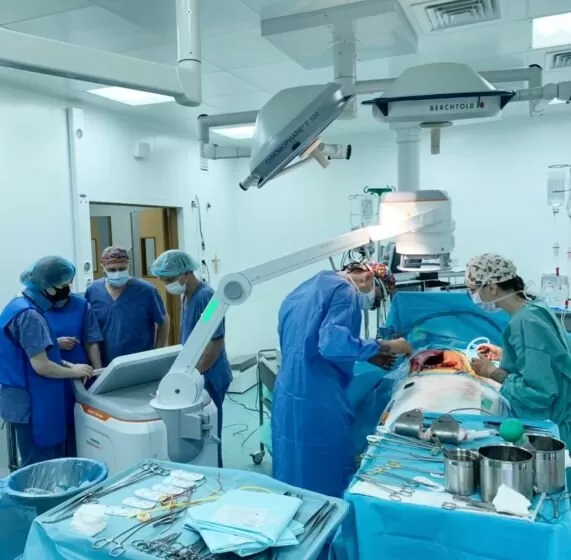
Come in for a consultation if an ultrasound found stones or you've already had an attack of pain under the right ribs. At Oberig clinic, we perform abdominal ultrasound on an expert-class ACUSON Sequoia (Siemens) scanner and give you the report right away. A surgeon will explain if you need an operation and, if so, perform a laparoscopic cholecystectomy in our OR1 KARL STORZ operating room.
Book by phone at +38 044 521 30 03 or online.